
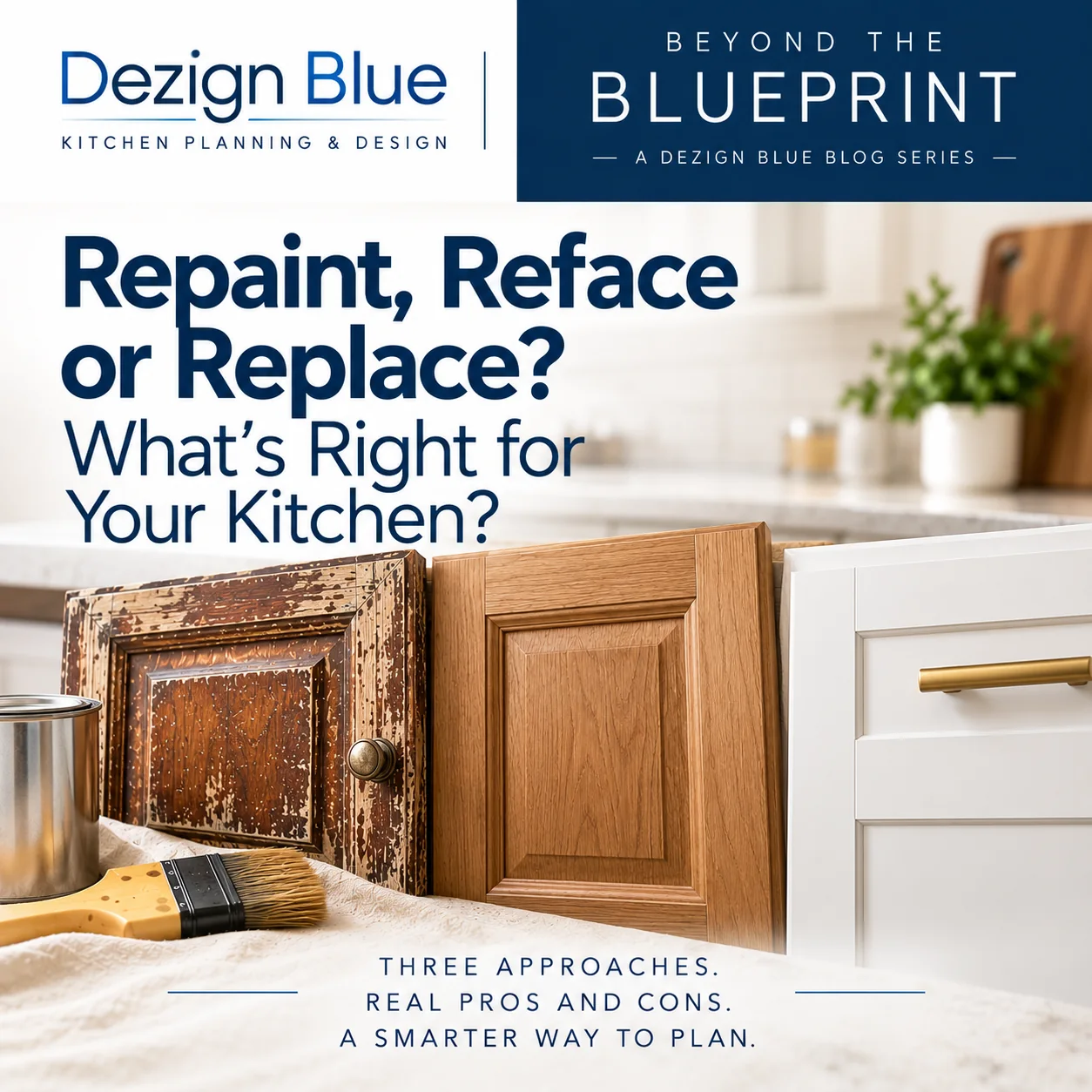
Repaint, Reface, or Replace? How to know what’s right for your kitchen.
With so many homeowners trying to make smart decisions in today’s economy, I’m hearing the same question more and more often:
“My kitchen or bathroom badly needs updating. Should I repaint, reface, or just replace the cabinets?”
It’s a good question—and there isn’t one answer that works for everyone.
I’ve worked with homeowners and repeat clients for many years, and I’ve learned that the best place to start isn’t with a cabinet door style or a paint color. It’s with an honest look at what you currently have.
Sometimes a simple repaint is all that’s needed. Sometimes refacing makes perfect sense. And sometimes, trying to save the existing cabinets can actually cost you more in the long run.
When Repainting Makes Sense
Repainting can be a great option when the cabinet boxes, drawers, hardware, and overall layout are already in very good condition.
If you love the way your kitchen functions, you’re happy with the amount of storage, the pantry pull-outs and interior fittings work well, and you love your countertops, a quality paint job can give the kitchen an entirely different appearance without changing everything else.
But there’s an important caveat: not every cabinet door is a good candidate for painting.
Most laminates, thermofoil, MDF-based, and other manufactured surfaces can be difficult and/or not possible to paint successfully.
For sturdy cabinet doors and drawer fronts, thickness matters, too. Most quality doors and drawer fronts will be around 5/8″ to 3/4″ thick. Some can be as thick as 1″, particularly when a J-pull or integrated handle is built directly into the door.
So before deciding to paint, it’s worth determining exactly what your existing doors are made of and whether they’re suitable for a quality finish.
When Refacing Makes Sense
I’ve worked with several clients who purchased homes with excellent cabinet boxes and interiors—but dated or damaged doors and drawer fronts.
The cabinets themselves were solid. The drawers had beautiful soft-close hardware. The interiors had well-designed pull-outs and storage features. The problem was that the exterior was dated, not the client’s taste, or just not wearing well.
In those situations, refacing can be an excellent solution.
I look at the stability and sturdiness of the cabinet boxes first. Then I look at the countertops and ask my client some important questions:
Do you like the layout?
Do you have enough storage?
Do the drawers and interior fittings work the way you want them to?
Do you absolutely love the countertops?
If the cabinet boxes are solid and you love the way the kitchen functions, replacing the doors and drawer fronts may give you the new look you’re after without replacing the entire kitchen.
But there’s another consideration that is often overlooked.
If the countertops need to be replaced anyway, the cost equation can change significantly. At that point, it’s worth comparing the cost of refacing with the cost of starting over with new cabinetry.
When It’s Time to Replace
Sometimes the answer is simply: it’s time for new cabinets.
I recently visited one of my repeat client’s rental properties in Beverly Hills. The property is a beautiful Spanish-style six-plex, and the kitchen hadn’t been remodeled in approximately 30 years.
The existing cabinets had one advantage: their shallow depth provided plenty of walk-around space.
But the doors and drawer fronts were cracked, chipped, and showing decades of normal wear. Some of the doors barely closed properly.
The tenant had suggested giving the cabinets a good coat of paint.
I knew immediately that paint wasn’t going to solve the problem.
A coat of paint wasn’t going to make those doors close properly. It wasn’t going to make 30-year-old drawers open and close smoothly. And it wasn’t going to address the underlying age and condition of the cabinetry.
This kitchen needed to be replaced.
That’s an important distinction.
A new finish can change how a cabinet looks. It can’t necessarily change how an old cabinet functions.
The Cost of Refacing vs. Replacing
There’s another reason I encourage clients to look at the entire picture before choosing to reface.
Refacing can sometimes cost more than people expect—and in some situations, it can even approach or exceed the cost of new, standardized cabinetry.
Why?
Because you’re not simply ordering a new set of doors off a shelf.
A kitchen designer or cabinet maker may need to measure every door, drawer front, decorative strip, toe-kick, filler, and trim piece individually, often to the nearest 1/16″ or even 1/32″.
Those pieces then have to be custom manufactured to fit your existing cabinetry.
And remember: when you reface, you’re keeping what’s inside.
If your existing cabinets are 10, 15, or 20 years old, the manufacturer may no longer exist, the original cabinet line may have been discontinued, or newer versions may have significantly improved storage and hardware.
Your new doors may look beautiful, but you’ll still be using the same old cabinet interiors, shelves, drawers, and pull-outs.
That’s why I don’t believe in automatically recommending refacing simply because it sounds like the less expensive option.
So Which One Is Right for You?
The answer comes down to more than how your cabinet doors look.
You need to consider:
- The condition of your cabinet boxes
- The age and condition of your drawers and hardware
- Your existing layout
- Storage capacity and interior features
- Your countertops
- The materials used for your existing doors
- How much you actually like the way your kitchen functions
- And, of course, your budget
Sometimes repainting is the smartest choice.
Sometimes refacing is the right choice.
And sometimes replacing the cabinets is actually the better value.
The trick is knowing which situation you’re in before you spend the money.
Start With Good Advice
My suggestion is to talk with a kitchen designer who is willing to look at your existing kitchen objectively—not someone who automatically assumes you need an entirely new kitchen.
Look for a designer who has the experience to recognize when your existing cabinets are worth saving, when refacing makes sense, and when you’re better off replacing them.
A good designer should be interested in helping you create your Dream Kitchen without spending money where you don’t need to.
Sometimes the smartest remodeling decision isn’t about spending more.
It’s about spending your money in the right place.
When you’re ready to chat about your kitchen remodel, call us at (323) 496-9104, email us at dezignblue@gmail.com or schedule a Free Consultation.